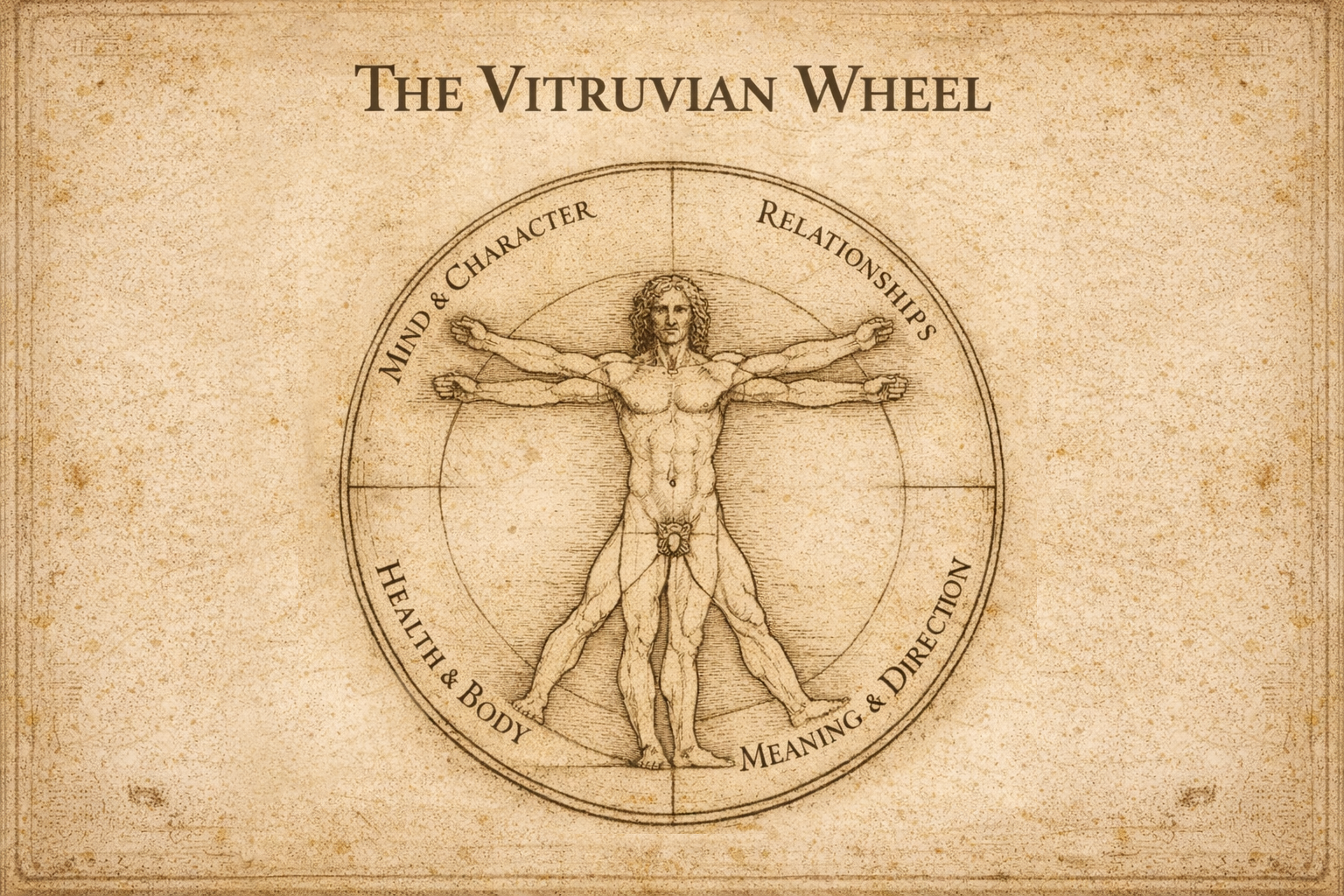
Maslow was right.
But the shape was wrong.
A short philosophical text that reframes human development as balance under motion... not a ladder to climb, but a wheel to maintain.
Life does not ask for completion. It asks for attentiveness and a way of seeing where weight accumulates and what requires care for a life to endure.
What this is
This microsite exists to host The Vitruvian Wheel in its original form... quietly, without promotion, and without urgency.
Many people today are exhausted not because they have failed,
but because they have been walking towards the wrong geometry:
"...climbing ladders that never end,
...measuring themselves against moving standards,
...comparing lives that were never meant to be compared."
Human life is not a climb.
It moves in cycles. It turns.
“Meaning is not found by reaching the top,
but by learning how to stay balanced while moving through time.”
The full text is available as a PDF.
If something here resonates, read it privately and at your own pace.
What’s inside (chapter overview)
A quiet orientation, not a programme.
This is for those who sense that something essential is being carried and who want a way of standing that does not collapse under time.
The chapters do not build upon each other as steps.
They turn around the same life... again and again, each time from a different angle.
Read them in order if you wish.
Pause when something tightens.
Return when life re-applies weight.
CHAPTER I
Nobody Cares
Many people live with the quiet pressure of being watched by timelines, by expectations, by imagined verdicts. This chapter names what happens when that pressure falls away, and how freedom appears not as indifference, but as relief from performance. If you have ever felt exhausted by being “on,” this chapter may allow something in you to exhale.
CHAPTER II
Meaning
Freedom does not last on its own. Left unattended, it drifts into withdrawal or numbness. This chapter explores how meaning returns... not through reward or recognition, but through care that is chosen freely and carried without coercion. If you have ever asked what is worth caring about, once applause no longer matters, this chapter may help you orient.
CHAPTER III
Becoming
Meaning sustained over time leaves a trace. That trace is not achievement... it is formation. This chapter turns attention towards what remains when nobody is watching... the patterns you repeat, the standards you keep, the care you maintain quietly. If you sense that your life is shaping you... even when nothing dramatic happens, this chapter may help you recognise that process without rushing it.
CHAPTER IV
Maslow Was Right… But the Shape Was Wrong
Many people have done everything “right”... and still feel unsettled, incomplete, or late. This chapter questions the inherited geometry that taught us to imagine life as ascent and reframes human development as balance under motion rather than arrival. If success has not brought the resolution you were promised, this chapter may explain why... without diminishing your effort.
CHAPTER V
Life Is a Wheel… Not a Ladder
Time does not lift us upward. It turns us back towards the same themes under new conditions. This chapter introduces the Wheel as a humane geometry... one that explains repetition without labelling it failure. If you have ever wondered why the same tensions return despite progress, this chapter may change how you understand movement itself.
CHAPTER VI
The Four Arcs
No life is carried in a single dimension. Every human moves within the body, the mind, relationships, and meaning... always. This chapter names those arcs without ranking them and replaces moral judgement with attentiveness to imbalance. If you have felt pulled apart by competing demands, this chapter may help you see your life as uneven rather than broken.
CHAPTER VII
Cracks… Not Failure
Strain is often interpreted as inadequacy. This chapter challenges that reflex. Cracks are reframed as signals of load... information rather than shame, while still insisting on responsibility for what the signal reveals. If you have felt something in your life straining or wobbling, this chapter may help you read it without self-accusation or denial.
CHAPTER VIII
From Perfection to Completeness
Perfection promises control. Completeness requires presence. This chapter explores how the pursuit of “being better” often fractures wholeness, and why inhabiting life fully is harder and quieter... than improving it. If comparison has made your standards feel violent rather than clarifying, this chapter may offer a gentler discipline.
CHAPTER IX
Why Comparison Breaks the Wheel
Comparison feels natural. It also distorts almost everything it touches. This chapter explains why measuring yourself against other lives, ignores terrain, load, and scale and produces shame instead of clarity. If comparison has quietly eroded your sense of proportion... this chapter may help you return to self-reference without withdrawal.
CHAPTER X
Terrain
Not all wheels roll on the same ground. This chapter introduces context... birthplace, circumstance, timing, not as destiny, but as diagnostic reality. Effort is reframed without romance or cruelty, and pace is restored to compassion rather than judgement. If you have wondered why progress feels harder than it “should,” this chapter may help you diagnose without despair.
CHAPTER XI
Scale of the Wheel | Founder as a Stance
Some lives carry small cycles. Others choose responsibility that widens consequence dramatically. This chapter explores how scale increases responsibility, slows progress, and amplifies the cost of neglect... without turning excellence into hierarchy. If you have taken responsibility for something that must endure, this chapter may help you understand why readiness matters more than speed.
CHAPTER XII
Ithaka… Keep Walking… Becoming
A Compass for Perspective and Continuity. After alignment settles, a quieter question remains... how to continue without clinging, controlling, or arriving. This chapter returns to Ithaka... not as destination, but as recognition and reframes continuity as stewardship rather than possession. If you are ready to walk without needing to finish, this chapter may feel like recognition rather than instruction.
EPILOGUE
Permission to Stay Unfinished
The Responsibility That Was Always Yours
The Responsibility That Was Always Yours
Most books end by resolving something. This one returns responsibility gently, without urgency. Here, finishing is released as an expectation, and responsibility is reframed as faithfulness to what your nature can carry. If you have felt both relief and weight while reading, this closing may help you hold both without contradiction.